
How Does Fidya Foundation Support Orphans and Needy People?
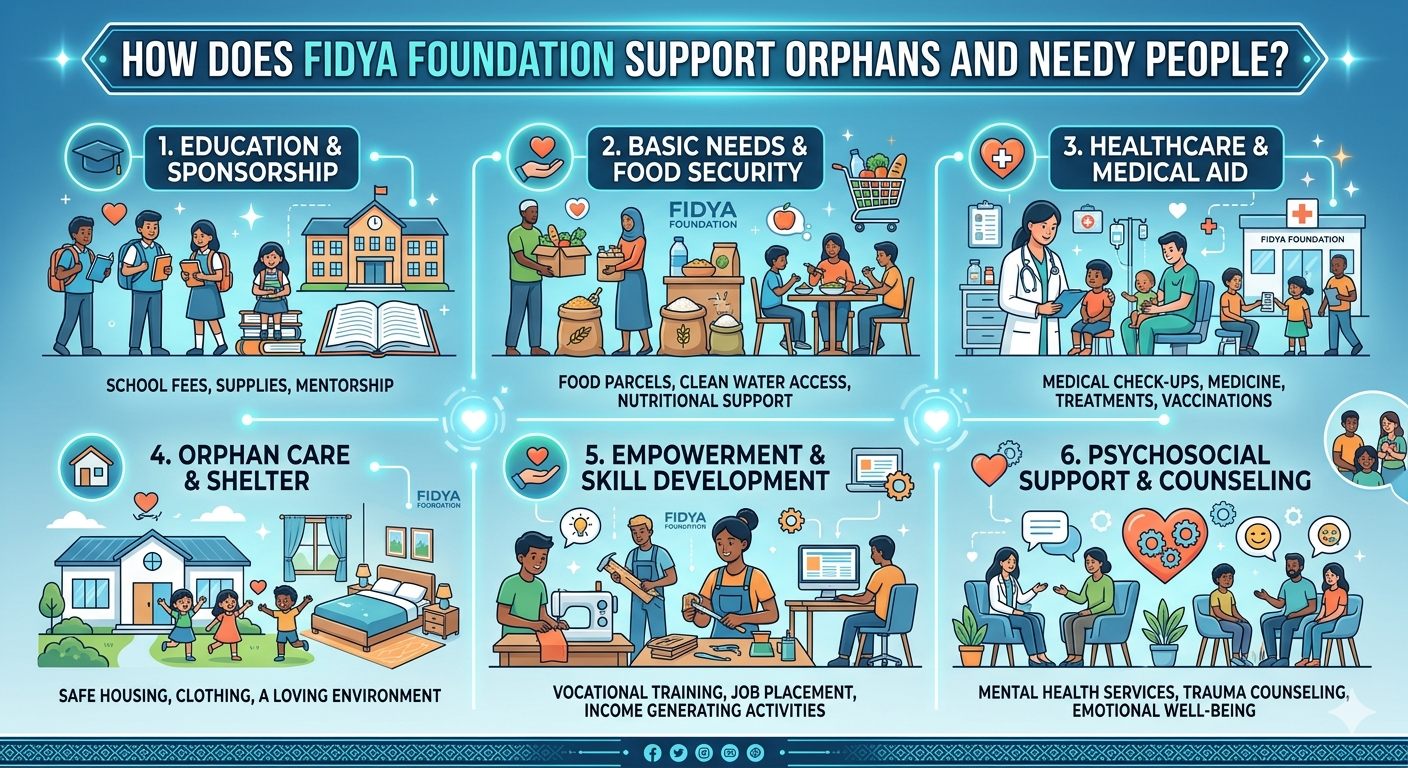
Let me tell you something most people don't think about when they hand over their Fidya money.
They pay it. They feel the relief of fulfilling an obligation. And then — they never find out what happened to it. Which family ate because of it. Which child went to sleep that night with a full stomach instead of an empty one.
That gap between giving and knowing — that's exactly what drove the people behind Sadaat Foundation to set up a proper Fidya Foundation in Mardan.
Mardan is not a small, forgotten town. It's the second largest city in Khyber Pakhtunkhwa. And yet, right in the middle of it — and in the villages stretching out beyond its borders — there are orphans, widows, sick elderly men and women who go through Ramadan without enough to eat. We've seen it. Our people have sat in those homes, drunk chai with those families, heard their stories. This isn't desk work.
So when Fidya comes in, we know exactly where it goes.
How Much Is Fidya for 1 Roza in Pakistan?
Honestly, this is the one thing everyone asks us in Ramadan — and we're glad they do, because getting this wrong means someone doesn't give what they owe, or gives less than what a needy person actually needs.
For 2026, the Fidya for one missed fast (1 Roza) in Pakistan sits at around PKR 300 to PKR 400. That's per day, per fast. It's worked out from the price of feeding one poor person a day — usually based on roughly 1.75 kg of wheat or its local equivalent. The exact number gets announced by scholars and Ulema before Ramadan, and we follow whatever is officially set for KPK.
It's not a huge amount. But multiply it across 30 days, across hundreds of donors — and it becomes something that can feed entire families.
How Much Is Fidya Payment in Pakistan for Ramadan 2026?
If someone can't fast at all during Ramadan — because of old age, a permanent illness, or a chronic condition that makes fasting genuinely dangerous — the total Fidya payment in Pakistan for 2026 comes to roughly PKR 9,000 to PKR 12,000 for the full month.
That's 30 days multiplied by the daily rate. Simple calculation, but people still call us confused about it — and that's fine, we'd rather explain it properly than have someone pay the wrong amount.
At Sadaat Foundation, we update our accepted Fidya rate every year based on the official announcements. We don't make up our own numbers. Religious compliance isn't optional for us — it's the whole point.
What Is the Amount of 30 Roza Fidya in Pakistan?
Same answer — but since people search this separately, let's be clear. The 30 Roza Fidya amount in Pakistan for 2026 is approximately PKR 9,000 to PKR 12,000, depending on provincial rates and scholarly guidance.
When that amount lands with us at Sadaat Foundation, here's what we actually do with it. Our distribution team sits down, matches the amount to verified beneficiary families in our records, and puts together food packs — flour, rice, cooking oil, dal, sometimes tea and sugar because a hot cup of chai matters too, especially to an elderly person living alone.
Then we deliver. Door to door, in Mardan district.
How Much Is Fidya for Missed Fasts in 2026?
Say you missed 10 fasts due to a surgery. Or 15 because of a hospital stay. The math is still the same — daily rate multiplied by the number of fasts you missed. If you missed all 30, pay the full 30. If you missed 8, pay for 8.
Where people get stuck is when they're not sure whether their condition qualifies. That's a question for a scholar, not us — but once you have that answer, we're here to receive the Fidya and make sure it reaches the right people through our healthcare charity foundation in Pakistan network.
We also help you calculate if you're confused. Just message us.
Can I Kiss My Girlfriend During Ramadan?
This question gets searched thousands of times every Ramadan in Pakistan and among Pakistani communities abroad. It's worth answering properly.
For married couples, scholars generally allow mild, non-passionate affection as long as it doesn't lead anywhere further and doesn't risk breaking the fast. For unmarried couples — Islamic guidance is clear that the relationship itself needs to be within the boundaries Islam sets, regardless of the month. Ramadan isn't just about food and water. It's a full reset of how we live, think and act.
And part of that reset, honestly, is giving. Fidya is one of the easiest, most direct ways to put Ramadan's spirit into action — turning a personal obligation into real food on someone else's table.
How Sadaat Foundation Gets Your Fidya to Orphans and Needy People in Mardan
Here's the part we're most proud of — and also the part most foundations don't talk about openly.
Sadaat Foundation runs as a non-profit health organisation in Mardan. We're not just a Fidya collection counter. We run community health development programs, door-to-door health visits, and maternal and child healthcare services in areas where there's no nearby clinic and no one else is showing up. That ground-level presence is what makes our Fidya distribution actually work.
We already know the families. We already know who lost a father last year. We know which grandmother has no one checking on her. When Fidya season comes, we don't have to start from scratch figuring out who needs help — we already have verified lists because we're there year-round.
Families we prioritise when distributing Fidya include orphaned children who've lost their primary earner, widowed women raising kids on their own, elderly individuals with no family income, and people already engaged with our rural medical support initiatives who can barely afford food while managing a health condition.
Our public health awareness campaigns have brought us deep into communities that don't trust outside organisations. That trust took years to build. And it means your Fidya doesn't get wasted on paperwork or middlemen.
What Means — And How Sadaat Foundation Demonstrates It
Our Experience comes from years of on-ground work in Mardan — distributing aid, running healthcare services in Mardan, sitting with families in their homes and understanding what they actually need versus what organisations assume they need. We don't theorise about poverty in KPK. We work inside it.
Our Expertise comes from having operations reviewed by qualified Islamic scholars for Shariah compliance, and from trained professionals delivering our maternal and child healthcare services.
Our Authoritativeness means we're a registered, documented organisation — not a WhatsApp group collecting money with no accountability.
And Trustworthiness? Every rupee gets tracked. Every beneficiary gets recorded. Donors hear back from us.
Real example — last Ramadan, a mother of four from a village outside Mardan reached out through a community health worker we'd placed in that area. Her husband had died earlier that year. She had no income and was too proud to ask anyone in her own neighbourhood for help. Our team had her on record. When Fidya came in, a ration pack — flour, rice, ghee, dal, tea — went to her door within days. Four children ate because someone in Dianella, Australia paid their Fidya through us.
That's the chain. That's how it works.
For the Pakistani Community in Dianella, Australia
Sending money back home from Australia comes with real anxiety — will it reach the right person, or disappear somewhere along the way? The Pakistani community in Dianella has found in Sadaat Foundation a health foundation in Mardan they can actually verify. We send WhatsApp confirmations, share beneficiary details (with family consent), and issue receipts. Your Fidya leaves Australia and lands in Mardan — not in someone's pocket in between.
FAQs — Fidya Foundation Mardan | Sadaat Foundation
Q1: Is Fidya the same as Kaffarah?
No — these are two different things. Fidya is paid when someone simply cannot fast, like an elderly or chronically ill person. Kaffarah is a much heavier penalty for someone who breaks a fast intentionally without a valid excuse. Fidya is gentler and food-based. Kaffarah involves fasting 60 consecutive days or feeding 60 people.
Q2: Can I pay Fidya on behalf of my elderly parents?
Yes, you can. If your mother or father is too unwell or too old to fast and they can't pay themselves, the responsibility falls on the family to cover it. We can help you work out the exact amount based on their number of missed fasts.
Q3: Does Sadaat Foundation only do Fidya work during Ramadan?
Fidya is collected during Ramadan because that's when it's due — but our work with orphans, widows and needy families in Mardan runs all year. Fidya is one funding stream among many we use to keep community health development programs running.
Q4: How do I know my Fidya actually reached someone?
We send back confirmation that includes the category of beneficiary (orphan household, elderly individual, widowed mother) and the distribution area. We don't publish personal details publicly, but donors get a proper acknowledgement — not just a thank you message.
Q5: Can someone who isn't Muslim donate to Sadaat Foundation's orphan support work?
Yes. Our non-profit health organisation in Mardan welcomes anyone who wants to reduce hunger and support vulnerable families — regardless of their background or religion. Hunger doesn't check faith before it hits.
Contact Us
If you want to pay Fidya this Ramadan and actually know where it goes — talk to us. Sadaat Foundation is a Fidya Foundation in Mardan that's been doing this work on the ground, not from behind a desk. Whether you're in Dianella, Australia, or anywhere else overseas, we'll make sure your obligation is fulfilled and your contribution reaches a family that needs it.
Drop us a message, ask us anything — Fidya amounts, how to calculate missed fasts, what happens after you pay. We're here.
📧 Email: info@saadatfoundation.org 📞 WhatsApp / Phone: [+92 334 9009550 ] 🌐 Website: www.saadatfoundation.org 📍 Based in: Mardan, Khyber Pakhtunkhwa, Pakistan